





How do you know when your vehicle needs new shocks or struts?
As a driver, it’s pretty obvious when you have tire failure; you can hear the noise created by a puncture or feel the damage while driving. Most drivers don’t notice when their shocks or struts fail because it happens gradually. Instead, drivers tend to adjust their driving without realizing they are compensating for extra roll or bounce.
Click on the thumbnail above
for a larger view.
Safety doesn’t happen by accident.
Worn shocks and struts can significantly reduce your ability to control your vehicle. For maximum driver safety, comfort, and control, Gabriel® recommends that you have your shocks or struts replaced every 50,000 miles.
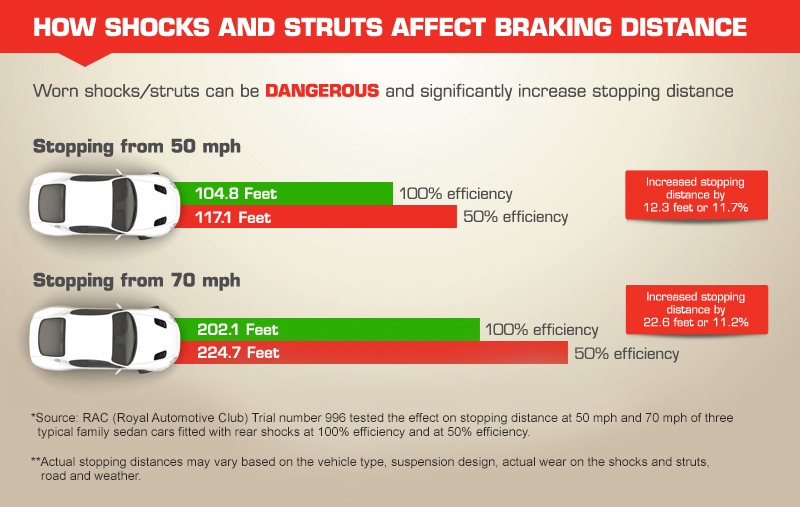
Shocks and struts also play an important role in helping your vehicle stop. Worn shocks and struts can significantly increase stopping distance by 12.3 feet or 11.7% when stopping from 50 mph, and by 22.6 feet or 11.2% when stopping from 70 mph. * **
* Source: RAC (Royal Automotive Club) Trial number 996 tested the affect on stopping distance at 50 mph and 70 mph of three typical family sedan cars fitted with rear shocks at 100% efficiency and at 50% efficiency.
** Actual stopping distances may vary based on the vehicle type, suspension design, actual wear on the shocks and struts, road and weather.
Can you recognize the signs of worn shocks and struts?
Below are some of the warning signs that may indicate worn shocks or struts. If you experience any of these signs, you should have your shocks or struts inspected by a qualified service technician immediately.

 |
Excessive Bounce On Rough Surfaces |
 |
Steering Wheel Vibrates |
 |
Uneven Tire Wear |
 |
Dented Or Damaged Housing |
 |
Nose-Diving When Braking |
 |
Noticeable Fluid Leaks From Shock Or Struts |
 |
Vehicle Veers In Crosswinds |
 |
Excessive Lean Or Sway On Turns |
There is no substitute for a thorough inspection by a qualified professional, especially every 12 months or 12,000 miles.
If you have additional questions, feel free to visit our FAQs page or call the Gabriel Answerman.
Gabriel cannot determine whether any particular customer is qualified to check or replace ride control, shocks or struts. Customers must make their own assessments of their experience, skills and knowledge and take responsibility for all results and if in doubt, seek the assistance of a qualified trained mechanic.
These videos are not intended to be step-by-step instructions, but are intended for general information purposes only.
Every vehicle is delivered with an OEM owner’s manual. If you cannot locate yours, several publications exist that will provide you with the specifications for the parts on the vehicle you are about to repair. Read the OEM manual specific to the make and model of your vehicle and the instructions that accompany your Gabriel product before undertaking any repair or replacement project. Always seek the advice or assistance of a qualified, trained professional when needed.
Before starting and vehicle repair or replacement project, you must have the proper training, tools, equipment and experience necessary to safely and correctly complete the project. This is especially important for anyone attempting to replace a worn strut or shock absorber, because failure to remove the worn part or install the replacement parts correctly on your vehicle may result in personal injury or damage to property.